Lets Conceive's
The Complete Fertility Test Checklist
Every test you and your partner need, when to get them, what the numbers should actually mean, and the warning signs that tell you it's time.


About the Guide
Identify Red Flags Early: Learn the cycle and body warning signs that mean you should get tested within the next 2 weeks.
Get the Complete Picture: Access the comprehensive list of hormonal, metabolic, and imaging tests for her, and the complete fertility panel for him.
Understand Your True Numbers: Compare your lab results against optimal ranges, not just standard disease-flagging ranges.
Stop Wasting Time: Close the gap where 6-12 months of unexplained trying often gets wasted.
Your gynaecologist checks if things are "normal." We check if things are "optimal for conception."
About the Guide
Trying to conceive but your reports look “mostly normal”?
Your HbA1c the 3-month blood sugar marker may be silently affecting your fertility.
This guide explains how sugar stability, stress, sleep, and metabolism impact hormones, ovulation, implantation, egg quality, and sperm health especially after 30.
It offers a gentle, couple-based plan to bring HbA1c down safely, without crash dieting or extreme routines.
The Essential Fertility Tests You Need
Key Tests for Her
FSH & LH:
Key Benefit: Checks ovarian function and PCOS markers.
Optimal Range:
FSH under 8 mIU/mL; LH ≤ FSH.
Usage Tip: Must be tested on Day 2-3 of your cycle.
Progesterone:
Key Benefit: Confirms healthy ovulation and luteal phase length.
Optimal Range:
Above 10 ng/mL (ideally 15+).
Usage Tip:
Test 7 days post-ovulation, not on a fixed Day 21.
Complete Thyroid Panel (TSH, Free T3/T4, TPO):
Key Benefit: Ensures metabolism is primed for pregnancy and checks for autoimmune risks like Hashimoto's.
Optimal Range:
TSH under 2.5 mIU/L.
Fasting Insulin:
Key Benefit: Identifies the root driver of PCOS and anovulation. This is the test most doctors skip.
Optimal Range:
Under 10 mIU/L.
Key Tests for Him
Semen Analysis:
Key Benefit: Checks the baseline quantity and physical quality of sperm.
Optimal Range:
Count 40M+/mL, Motility 50%+ progressive, Morphology 4%+.
Usage Tip: Perform after 2-5 days of abstinence.
Sperm DNA Fragmentation:
Key Benefit: Uncovers hidden damage linked to up to 80% of "unexplained" IVF failures and early miscarriages.
Optimal Range:
Under 15%.
Hormonal Panel:
Key Benefit: Ensures his internal environment supports healthy sperm production.
Optimal Range:
Fasting Testosterone 400-700 ng/dL.
How to Prioritise Tests Based on Your Symptoms
● If you have Irregular Periods:
Prioritise FSH, LH, Estradiol, AMH, full TSH panel, Fasting Insulin, DHEA-S, Testosterone, and Prolactin to identify PCOS, thyroid issues, or diminished reserve.
● If you have Unexplained Infertility:
Look for hidden "normal-but-not-optimal" markers by testing Fasting Insulin, Vitamin D, Ferritin, Full Thyroid Panel, correctly timed Progesterone, Sperm DNA Fragmentation, and Vaginal Microbiome.
● If you have Recurrent Miscarriages:
Focus on Progesterone, Full Thyroid + TPO Antibodies, HbA1c, Sperm DNA Fragmentation, and Vaginal Microbiome.
● If you have PCOS:
Test Fasting Insulin (not just glucose), LH:FSH ratio, Total Testosterone, DHEA-S, HbA1c, Full Thyroid, and AMH to identify your specific PCOS type and determine the right treatment.
The Truth Nobody Told You About "Normal" Reports
The Bad Approach:
Settling for "Normal": Lab ranges flag disease, not fertility readiness.
Skipping Male Testing: Male factor contributes to 40-50% of all infertility cases, yet crucial tests are rarely ordered.
Ignoring Timing: Testing FSH on Day 10 instead of Day 2 gives a meaningless number.
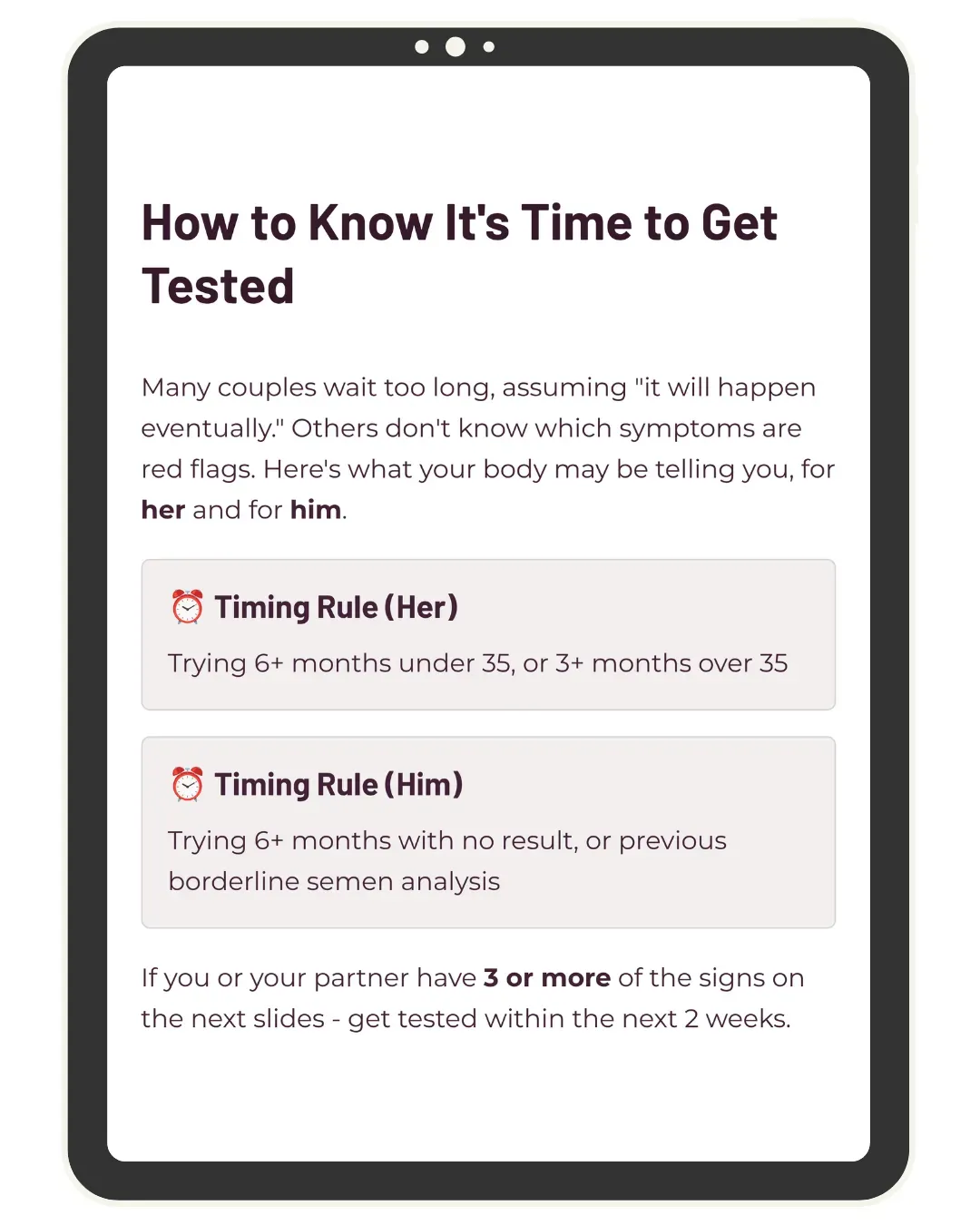
The Right Approach:
Aiming for "Optimal": For example, a TSH of 4.2 is "normal," but fertility endocrinologists recommend under 2.5 for conception.
Testing Both Partners: Including advanced male diagnostics like Sperm DNA fragmentation, the #1 hidden cause of failed implantation.
Testing on the Right Day: Wrong timing equals wrong results, which leads to wrong treatment.
💡 Consistency beats intensity.
Couples who stopped guessing
What was actually wrong, what they fixed, what happened. From the 90-Day Fertility Detox Program.
Ready for a Personalized Plan?
Every couple is different — your fertility strategy should be too.
At Let’s Conceive, we assess both partners and create a step-by-step plan based on your reports, cycle, lifestyle, and goals.
👉 Book a Consultation
💬 DM “HBa1c” on Instagram @letsconceive to get the booking link
🌐 Visit www.letsconceive.in
✨ Small daily habits create big fertility shifts. ✨